Effective Leadership Skills Training Course
Enhance the ability of the participants to successfully execute and deliver on the strategic objectives relevant to their highly competitive and volatile business environment.
 |
3-DAY WORKSHOP | HRDF SBL CLAIMABLE
FAQ & FURTHER INFORMATION
The need to imbibe skills that enable teams to push the boundaries of their expertise in dealing with peoples’ aspirations, in creating a learning environment, and above all, in leading partners and customers alike towards a new world. To do so, they need the ability to think critically and develop an innovative mind-set.
This course lays down the details of how these requirements may be met at a very practical level through an effective people management training program that will be undertaken online as well as in a face-to-face classroom-based setting.
What is proposed is an Effective Leadership Training Course for junior to senior managers that consists of a 3-day intensive face-to-face workshop session in which the participants will be exposed to key concepts relating to effective motivation techniques, developing a sense of accountability, and managing performance and staff accountability.
This Effective Leadership Skills Training Course usually be conducted in Kuala Lumpur, Malaysia

Terminal Objective
The terminal objective of this course is that participants will be able to experience first-hand how they should manage and lead their teams in a rapidly changing business environment. Essentially, they will be able to engage effectively with external stakeholders and enhance collaboration within the internal teams to integrate knowledge and skills to meet changing client expectations.
Key course outcomes
- Establish and communicate clear directions, while guiding team members through the completion of tasks;
- Leverage talent by increasing the motivation level of subordinates to enable self-leadership;
- Manage knowledge effectively and think critically when dealing with client and stakeholder requirements;
- Tactfully manage employees’ expectations across various demographic areas;
- Develop a culture of accountability and ownership while ensuring and understanding the importance of accountability and how it drives others to excel;
- Align Core Competencies to improve overall performance.
FEATURED CLIENTS
 |
 |
 |
 |
EFFECTIVE LEADERSHIP SKILLS COURSE SYLLABUS & OUTLINE
|
Time |
Activity |
|
9.00 |
Overview on importance of communication and staff motivation |
|
9.15 |
Concept of self-leadership |
|
9.30 |
Video clip: Importance of self-leadership
|
|
9.45 |
Group Based Discussion: How to develop self-leadership
|
|
10.15 |
Facilitator feedback on group-based discussion |
|
10.30 |
TEA BREAK |
|
10.45 |
Focusing on meeting objectives |
|
11.00 |
Optimising personal performance to achieve objectives set |
|
11.20 |
Video clip: Expanding capabilities by motivating others |
|
11.40 |
Group Based Discussion on video clip shown |
|
12.00 |
LUNCH |
|
13.00 |
Overview on aligning objectives with reality in the ground |
|
13.40 |
Developing shared understanding of business and departmental objectives |
|
14.00 |
Increasing motivation level of employees |
|
14.20 |
Group Based Discussion: Why employees do not seem to be motivated |
|
14.45 |
Facilitator feedback on group-based discussion |
|
15.00 |
TEA BREAK |
|
15.15 |
Impact of communicating directions and motivating staff on enhancing performance |
|
15.30 |
Case Study: Overcoming a Roadblock
|
|
15.45 |
Group Based Discussion: Resolving the roadblock faced |
|
16.30 |
Facilitator feedback on group-based discussion |
|
17.00 |
End of Day 1 |
FAQ & FURTHER INFORMATION
The 70:20:10 Model for Learning and Development has been found to be most effective within the training profession to describe the optimal sources of learning aimed at developing work based competencies. It holds that individuals obtain 70 percent of their knowledge from job-related experiences, 20 percent from interactions with others, and 10 percent from formal educational events.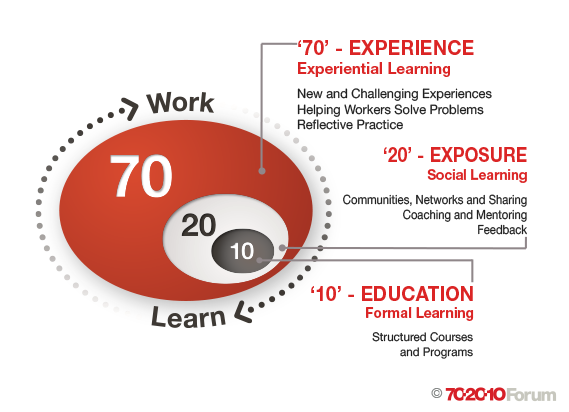
Based on this model, we propose that the Fundamentals of Project Management course be structured along similar lines. It is proposed that it is undertaken in stages. These stages will include awareness stage, appreciation stage and application stage.