
Organization
-

Every industry recognizes the value of learning. However, not all organizations are able to make the best use of their knowledge assets to learn continually. Hence, it's crucial to gradually introduce knowledge acquiring, sharing, and producing best practices into your organization.
Thus, it is recommended that you or your employees seek to be certified as Certified Knowledge Manager (CKM®). By being certified, they will be better positioned to optimise organizational learning to steer your company towards being a Learning Organization.
Many initiatives can be undertaken by a Certified Knowledge Manager, CKM who has acquired this certification from the Knowledge Management Institute, KMI. Such a person is thoroughly trained through a very practical approach to be sufficiently competent to undertaken the following which are crucial for successful implementation of Knowledge Management.
- Spearheading the need for transformation.
This is done through the development and communication of an appropriate call to action, definition of knowledge management as well as the development of a Knowledge Management methodology that is relevant to your specific requirements.
- Establishing precise metrics for developing and sustaining KM efforts.
Knowing your destination for your knowledge management strategy will help you determine the best course of action to take. However, defining your organization's objectives can be difficult if the metrics used for results is not carefully considered and aligned to the overall strategic direction. How activity as well as results metrics have to be developed are crucial aspects of demonstrating success in knowledge based activities.

- Undertaking Quick Wins and KM Transformation in an orderly manner
People generally don't like change, especially when it's done poorly. For this reason, creating a step-by-step implementation procedure for defining and undertaking “no budget KM initiatives” or quick wins is essential. To do this effectively requires careful consideration of a number of key steps that are essential for ensuring success both in developing quick wins as well as engaging in overall transformation into a Learning Organization.
- Overcoming barriers to successful implementation of Knowledge Management .
Based on more than twenty years of experience in this field, an entire spectrum of barriers to implementing KM has been identified. These barriers have to be proactively managed in advance to accelerate the ability to identify and overcome them with best practices.
The above competencies will be developed through an intensive 5 days session conducted by an official Knowledge Management Institute Instructor who has demonstrated the abilities to develop such competencies. Those who are interested, please click on the link below to have a look at our Certified Knowledge Manager (CKM®) Certification, https://bit.ly/3f8Yb4c.
By: Sharma Management International
-
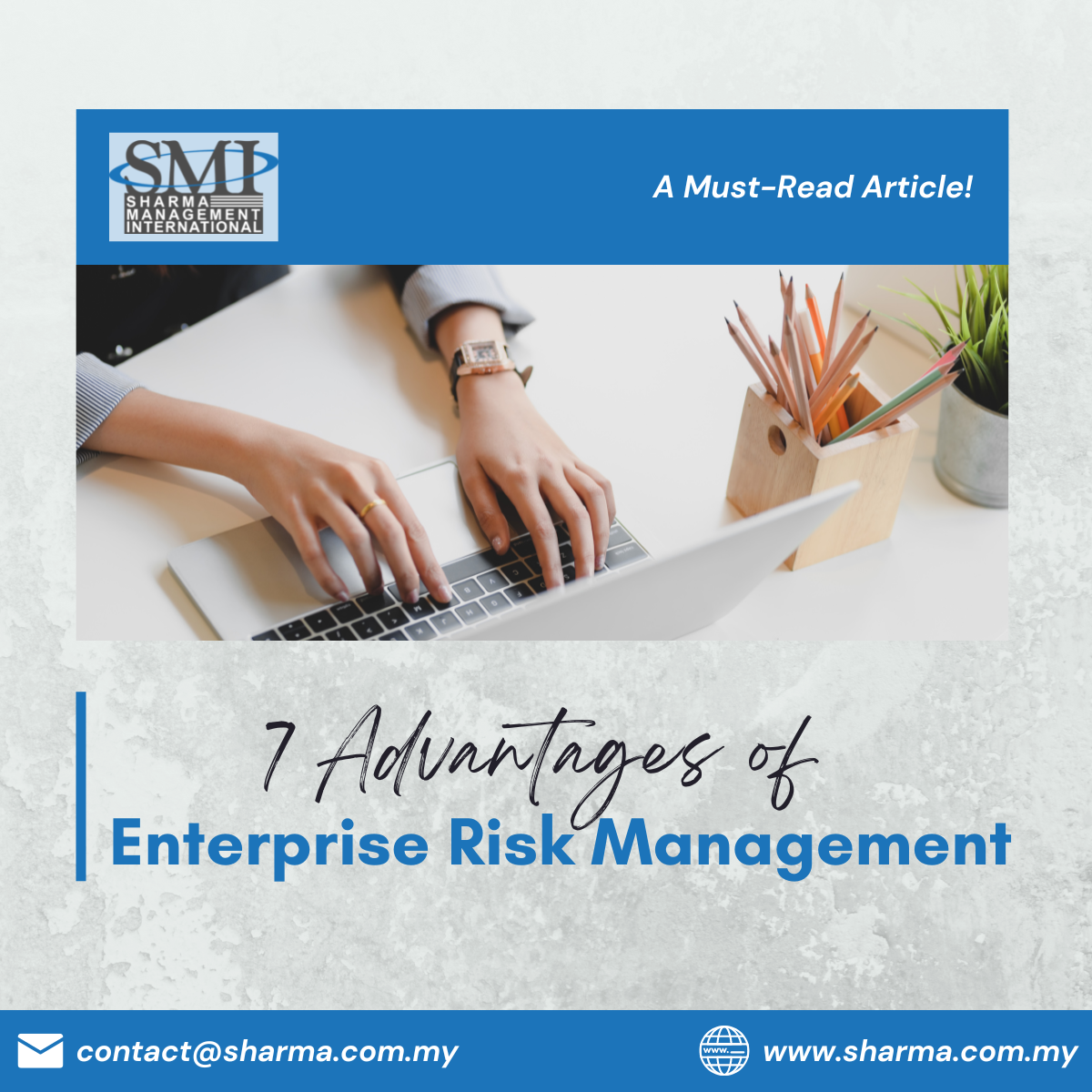
As you might expect, enterprise risk management is a risk management strategy used throughout the entire organization. The idea of ERM was first presented in the 1990s, and as businesses have come to appreciate its advantages, it has spread across industries with increasing frequency.
Hence, let's examine the advantages of enterprise risk management in more detail.
- Increases your organization's awareness of its risks and ability to respond to them.
Because it addresses all facets of organizational risk exposure, including financial, operational, reporting, and compliance, enterprise risk management has the benefit of providing oversight. By giving teams on the ground actionable, real-time insight or giving the board a bird's-eye view of risk, ERM significantly improves your ability to respond to the corporate threats you face.
- The capacity to adhere to legal and regulatory requirements better.
ERM guarantees that you will be able to comply with all reporting requirements and other legal obligations. The likelihood of regulatory compliance violations is reduced because it gives you the data you need to demonstrate compliance and the assurance that all threats have been successfully addressed.
You will learn how to successfully undertake the second advantage throughout two (2) days of online sessions under the "Enterprise Risk Management Training Course" regarding legal and regulatory requirements.
- It increases your confidence in your ability to achieve strategic goals.
Your objectives will become attainable once you are confident that all potential threats to your strategic objectives have been located and neutralized. Every possible curveball is something that you have planned and can be used to your advantage.
- It appears that ERM gives leadership control over risk.
Your board and executive team will be more receptive to hearing about your risk profile. With the help of customizable storyboards and one-click reports, you can gain immediate access to information about risks and opportunities while also giving executives and other stakeholders the necessary risk data and analysis. You can easily demonstrate how risk affects your entire company to the leadership by outlining risk in detail for them.

- You conduct business with greater effectiveness and efficiency.
Your risk exposures are prioritized and managed by ERM as a connected portfolio instead of being addressed in separate silos. When the risk is managed solely through individual risk management programs, operations are less effective and successful than when the risk is evaluated holistically and in the context of all internal and external environments, systems, conditions, and stakeholders.
- Risk management is incorporated into routine business activities.
The ability of enterprise risk management to be integrated into your business processes is an additional advantage. You can effectively identify, assess, and monitor risks before they become a problem if you have a clear framework for managing all risks, whether strategic, financial, IT-related, quantitative or qualitative, or third-party.
- You can proactively identify threats across your entire organization and take appropriate action.
You can quickly spot inconsistencies, outliers, and anomalies thanks to ERM's ability to automate risk monitoring tasks and make use of advanced risk analytics. You can consequently recognize risk trends and foresee risks with speed.
The proactive approach to risk that enterprise risk management fosters allows companies to use risk management as a competitive advantage, which is one of its main benefits.
The skills above will be developed through an intensive 2 days session conducted by an official Knowledge Management Institute Instructor who has demonstrated the ability to develop such skills in Enterprise Risk Management.
By: Sharma Management International
-
2026 Update: While the core Agile principles discussed here remain highly relevant, Scrum practices and certification tracks have evolved. To master the latest frameworks and get certified, view our fully updated Scrum Master Certification Course in Malaysia for the latest class schedules and HRD Corp claimable options.

For plants to grow, they need fertile soil and good irrigation. If either one of this is lacking, the growth is impeded. Fertile soil provides nutrients to the plants and water enables the plant to photosynthesize sunlight. If water is completely cut off or if the soil becomes infertile, the plant dies. Hence a gardener’s primary focus is to ensure the soil is fertile and a continuous source of water is always provided.
Being agile means being able to quickly detect changes as they unfold and respond appropriately to take advantage of that change. Employees within an organization tend to be agile when they understand the importance of developing knowledge sharing capability and adaptability. Knowledge sharing is critical for an organization to quickly sense changes to an environment. Adaptability is critical to be able to respond to changes in the environment.
Just as the analogy above suggests, as long as there is water and the soil is maintained well, the plant will grow. Similarly, as long as knowledge sharing at an organizational level is actively instituted and the key nutrients for adaptability are nurtured, employees will be accountable for adapting and delivering results. Over time, with better ability to detect changes and adapting appropriately to change, the level of agility improves. Hence, management’s key focus should be to continually improve organizational knowledge sharing and adaptability in the face of changing business requirements.
The key nutrients for adaptability of an organization towards environmental changes is premised on its ability to
- Create change as and when the need to do so arises
- Focus on the needs of the customer, that is, being customer centric
- Engage in practices that contribute to being able to learn, unlearn and relearn faster
All organizations are agile to some extent. Organizational agility is not something you either have or don’t have. It is something that varies on a sliding scale. The concern is whether your organization is sufficiently agile to deal with the business environment that it is in. If the need for agility and the rate at which your organization increases its agility capabilities do not match up, you will be severely impacted. To keep pace and ensure continual growth in agility requires an ability to assess how agile your organization is. For this, an assessment tool for agility is required.
The lack of a validated and reliable assessment tool for agility is a severe impediment. Such a tool should be able to assess the degree to which essential requirements for agility are met. They should be easily administered to respondents and contain questions that are both relevant to assessment of agility and validated by well-established models.
Unless accurate and reliable assessments of the extent which agile practices are being undertaken in practice, concrete attempts to improve the maturity of agile practices will be hampered. This in turn will frustrate attempts to develop an agile based workforce that embraces the culture of flexibility and self-organization. With such a tool in place, it becomes possible to assess how well your organization fares in terms of creating change, being customer centric and engages in knowledge sharing practices.
Sharma Management International, in associated with its international partners, has developed a validated and reliable assessment tool that measures the degree of agility in organizations. This assessment is based on validated models that are relevant to measuring agility.
For a trial assessment and a more detailed proposal regarding Agility Maturity Assessment Tool, on how Agile your organization is, please contact us here.
 |
 |
 |
 |
 |
 |