
Agile
-

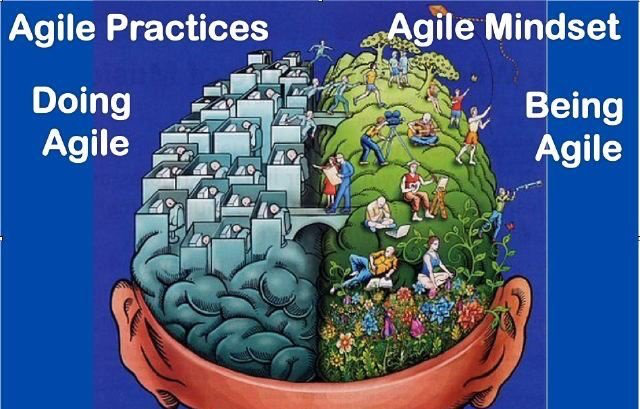
There is a very serious misconception that doing agile means being agile. Such a misconception impedes organizational attempts to pursue the part of agility. By equating being agile with doing agile, it is assumed that when agile practices and routines are undertaken using the scrum methodology, the transition from the conventional way of working to a new, better way of working is occurring.
Being led by this assumption, the tendency to upskill employees in agile practices and routines so that they begin to “do agile” overshadows the realization that doing agile does not lead to being agile over time. Hence employees learn what to but do not internalize the need to do so. They are merely doing agile, not being agile.
Being agile essentially focusses on empowering employees to harness knowledge assets to acquire and create new knowledge. The primary focus is on developing a culture of knowledge sharing that is premised on a Sense-And-Respond mindset. There is a heightened level of sensitivity of changes and the ability to respond appropriately is emphasized. Such a culture is premised on a mindset attuned towards navigating the trials and tribulations associated with turbulent business environments.
Doing agile occurs when people have been given the mandate by management to adopt scrum methodology in accordance with agile principles. They “have to” change what they do and follow strictly scrum approach based on agile practices and routines. This leads employees to believe that management knows best and they oblige blindly. The command and control mindset predominate and the culture of subservience continues albeit in a different tone. In this case, the organization may be doing agile but is not being agile.
Having a heightened state of awareness that agility essentially means developing a new way of thinking and doing is a good starting point. This awareness should be directed towards developing a desire to empower employees to seek out new innovative ideas around new problems. One effective approach used is called question storming, a session aimed at encouraging people to ask as many questions as possible to encourage them to be inquisitive. By creating an environment where being inquisitive and seeking alternative options is encouraged, more innovative ideas emerge.
How they do so in a structured and systematic way would be by adopting certain principles and practices of agility that suits them best.
When emerging problems are solved using agile practices such as updating physical planning walls for increased visibility, these practices become ingrained in the culture of the workforce. These practices serve as instruments that are used to facilitate quick decision making, encourage collaborative interaction and developing flexible processes that increases an organizations resilience. Resilience against in the face of challenges posed by volatility, uncertainty, complexity and ambiguity. This develops over time when an environment that nurtures agility and transparency is fostered by management who willingly shed the notion that “they know best”
Over time, agile practices become the norm and this facilitates the process of harnessing knowledge assets to remain ahead of the curve. When this happens, an organization is said to be agile, not one that just does agile. This should be the primary aim and focus of organizations pursuing the path of agility.
-
The underlying purpose of any project is to add value. Projects serve as vehicles that enable changes, which should bring upon benefits that exceed the cost of making these changes.
As long as this occurs, a project is deemed to have been effectively and efficiently undertaken. Project managers are entrusted with the responsibility of ensuring that both the performing organization, as well as to the clients they serve, benefit from projects undertaken.
Given the very large number of interrelated considerations as well as the highly volatile environments in which projects operate, the prospect of adding value becomes increasingly difficult. Uncertainties that affect projects abound. Costs of undertaking projects continue to rise. Requirements from stakeholders become increasingly ambiguous. These factors detract value instead of adding value.
As project managers, we have to overcome any potential threats that impede the realization of this value. This include the need to protect the “Agile Ozone Layer”. This Agile Ozone Layer is usually attacked from multiple angles, from rigid and bureaucratic organizational structures, command and control style leaderships, to a functional silo mentality and resistant vendors and customers.
To ride the wave of such impediments that surface, a heightened sense of opportunistic awarenessbased on careful examination of business value undertaken throughout the project is required. Business Value refers to the net quantified benefits derived from the business endeavour being undertaken by the company.
This requires developing a sense of urgency for intelligent collection and analysis of relevant data to make decisions that enable realization of business value to the project as well as ensuring that the momentum of continual improvement is maintained. Doing the above correctly occurs only when project managers select project management methodologies that commensurate with the business environment the projects are undertaken.
Developing and maintaining a sense of urgency
When projects are to be executed based on evolving requirements in a highly turbulent business environment, the agile project management approach is most applicable. Such an approach requires a sense of urgency to be ingrained within the project team.

Changes have to be embraced and adapted to through collaborative efforts with customers. Only by developing a sense of urgency will the cost associated with delays in adapting to changing requirements can be curtailed.
Firstly, we shall have to establish a Product Roadmapthat provides an initial visual timeline based on the Project Vision. Then releases are planned using a Release Planningthat defines when deliveries may be made based on frequency of delivery as well as extent of adaptation required. A more incremental model approach, where deliverables are made at regular intervals, speeds up the delivery of value to the client.
For situations where there is no need for deliveries to be made incrementally, but there is a very urgent need for the features to be aligned perfectly to the changing requirements of the client, an iterative modelis adopted.
Realization of Business Value
To realize business value, a deep understanding of not only what the customer requires but also the value associated with those requirements has to be established.

The project team needs to ascertain the “why” behind the “what”. This is required for both the performing organization as well as for the client. The value or specific benefits the project delivers via the end deliverable needs to be understood and internalized.
This requires gradually uncovering all uncertainties within specific release cycles and working time blocks, that impede the ability of the project team to deliver the value that is expected. The ability to do so is enhanced when delivery is made incrementally based on priorities set by the client. This way, feedback from each incremental deliverable, as well as uncertainties uncovered, become valuable inputs for future deliveries. In this way the project “delivers value incrementally”, and in the process of doing so, enables realization of business value throughout the project life cycle.
Rapid Data collection and analysis
Successfully delivering value requires constant data collection and assessment of progress. It requires developing insights on what works and what does not. This is done not based on assumption, but on actual data.

To ascertain whether this is indeed the case, developers aim to produce what is called a Minimum Viable Product as a prototype. Such a product contains the smallest collection of features that enable customers to consider the product as being functional. This provides developers with an opportunity to test features and ascertain important improvement points quickly and effectively.
From the company’s perspective, this exercise also helps to establish what the smallest amount of value that can be added to a product or service that benefits the business as well. Collecting data on minimal new value propositions and the corresponding positive business impact provides an impetus for the company to decide quickly and effectively on what value additions it should incorporate in order to maximize business growth prospect. This concept of Minimum Business Increment focusses on therealization of business value.

In summary, delivering value requires a combination of collaborative efforts of all stakeholders who are committed towards developing and preserving an Agile Ozone Layer that makes it conducive to undertake agile project management.
A sense of urgency to deliver value needs to permeate throughout the organization. This urgency extends to rapid data collection and analysis where Minimal Viable Product and Minimum Business Increment considerations are routine initiatives undertaken using a delivery model based on an incremental or iterative approach.
-
2026 Update: While the core Agile principles discussed here remain highly relevant, Scrum practices and certification tracks have evolved. To master the latest frameworks and get certified, view our fully updated Scrum Master Certification Course in Malaysia for the latest class schedules and HRD Corp claimable options.

For plants to grow, they need fertile soil and good irrigation. If either one of this is lacking, the growth is impeded. Fertile soil provides nutrients to the plants and water enables the plant to photosynthesize sunlight. If water is completely cut off or if the soil becomes infertile, the plant dies. Hence a gardener’s primary focus is to ensure the soil is fertile and a continuous source of water is always provided.
Being agile means being able to quickly detect changes as they unfold and respond appropriately to take advantage of that change. Employees within an organization tend to be agile when they understand the importance of developing knowledge sharing capability and adaptability. Knowledge sharing is critical for an organization to quickly sense changes to an environment. Adaptability is critical to be able to respond to changes in the environment.
Just as the analogy above suggests, as long as there is water and the soil is maintained well, the plant will grow. Similarly, as long as knowledge sharing at an organizational level is actively instituted and the key nutrients for adaptability are nurtured, employees will be accountable for adapting and delivering results. Over time, with better ability to detect changes and adapting appropriately to change, the level of agility improves. Hence, management’s key focus should be to continually improve organizational knowledge sharing and adaptability in the face of changing business requirements.
The key nutrients for adaptability of an organization towards environmental changes is premised on its ability to
- Create change as and when the need to do so arises
- Focus on the needs of the customer, that is, being customer centric
- Engage in practices that contribute to being able to learn, unlearn and relearn faster
All organizations are agile to some extent. Organizational agility is not something you either have or don’t have. It is something that varies on a sliding scale. The concern is whether your organization is sufficiently agile to deal with the business environment that it is in. If the need for agility and the rate at which your organization increases its agility capabilities do not match up, you will be severely impacted. To keep pace and ensure continual growth in agility requires an ability to assess how agile your organization is. For this, an assessment tool for agility is required.
The lack of a validated and reliable assessment tool for agility is a severe impediment. Such a tool should be able to assess the degree to which essential requirements for agility are met. They should be easily administered to respondents and contain questions that are both relevant to assessment of agility and validated by well-established models.
Unless accurate and reliable assessments of the extent which agile practices are being undertaken in practice, concrete attempts to improve the maturity of agile practices will be hampered. This in turn will frustrate attempts to develop an agile based workforce that embraces the culture of flexibility and self-organization. With such a tool in place, it becomes possible to assess how well your organization fares in terms of creating change, being customer centric and engages in knowledge sharing practices.
Sharma Management International, in associated with its international partners, has developed a validated and reliable assessment tool that measures the degree of agility in organizations. This assessment is based on validated models that are relevant to measuring agility.
For a trial assessment and a more detailed proposal regarding Agility Maturity Assessment Tool, on how Agile your organization is, please contact us here.

 |
 |
 |
 |
 |
 |