Before You Invest in AI, Check Your Organizational Health
Why cultural readiness—not just technological capability—is the key to successful AI integration
AI: Promise or Pitfall?
Artificial Intelligence (AI) is no longer a futuristic buzzword. It’s here—powering customer insights, automating processes, and enabling predictive decision-making in businesses around the world. With its promise of cost savings, innovation, and operational efficiency, AI has become a strategic priority across industries.
But here’s the catch: investing in AI doesn’t automatically guarantee results. Many organizations rush into AI adoption assuming the technology alone will generate value. In reality, the success of AI hinges not on the tool itself but on the health of the organization that’s using it.
AI Requires More Than Algorithms
AI implementation is not a simple systems upgrade—it’s a strategic transformation that affects decision-making processes, workflows, job roles, and even the ethical posture of a company. If your internal environment is unprepared, the technology will underdeliver, or worse, create confusion, conflict, or cost overruns.

What’s often overlooked is that AI amplifies what already exists in the organization. If your business is aligned, agile, and purpose-driven, AI will accelerate your success. If your organization struggles with clarity, resistance to change, disengaged employees, or siloed operations, AI will only magnify these dysfunctions.
Four Pillars of Organizational Health
To integrate AI effectively, four foundational conditions must be in place: First, there must be clarity of business strategy. Employees need to understand why AI is being implemented and how it fits into the broader mission. Otherwise, AI risks becoming an expensive science experiment with no strategic impact.

Second, the organization must have adaptability in changing environments. AI is not a one-time deployment—it requires constant learning, iteration, and responsiveness. A rigid or risk-averse culture will struggle to derive value from AI initiatives. Third, employee involvement is critical. AI affects roles and responsibilities. When employees are engaged, they help shape, adopt, and improve the AI systems. When left out, they may resist or disengage from the transformation altogether.
Finally, successful integration depends on cross-departmental collaboration based on core values. AI projects often span multiple functions—from IT to operations to customer service. Without shared values and a collaborative spirit, efforts become fragmented, and the full potential of AI is never realized.
The Denison Model: A Proven Framework for AI Readiness
To assess whether these four conditions exist in your organization, a structured health check is essential. One of the most effective tools for this is the Denison Model—a research-backed framework used globally to assess and improve organizational effectiveness.
The Denison Model evaluates four key dimensions:
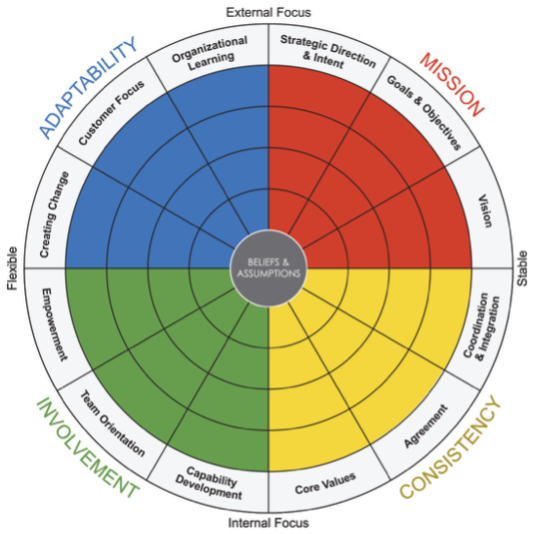
- Mission, which corresponds to strategic clarity. It reveals whether the organization has a clear direction that employees understand and support.
- Adaptability, which measures how well the organization learns from external trends, customer feedback, and internal data—core capabilities for any AI-driven business.
- Involvement, which captures the extent of employee empowerment and engagement—factors that significantly influence how AI is adopted and utilized.
- Consistency, which examines shared values, systems alignment, and coordination across teams—all of which are critical for ethical and scalable AI deployment.
These dimensions offer more than just insights; they provide actionable guidance for leaders to close cultural gaps, improve team readiness, and phase AI projects based on where the organization is most capable of success.
Build the Foundation Before the Future
In short, AI doesn’t solve organizational dysfunction—it exposes it. Implementing AI in a culture that lacks clarity, adaptability, collaboration, or engagement is like planting seeds in barren soil. The results may be patchy at best and disastrous at worst.
Before making the leap into AI, leaders should pause and ask: Is our organization ready to support this transformation? A Denison-based health check offers a low-cost, high-impact way to answer that question with confidence.
By assessing your organizational health first, you not only de-risk your AI investments—you set the stage for smarter, faster, and more sustainable innovation.
Ready to future-proof your AI strategy?
Start by checking the cultural pulse of your organization. Because when it comes to AI, your greatest asset—and risk—isn’t the tech. It’s your people and how they work together.
Contact us for more details on how to future-proof your AI strategy.